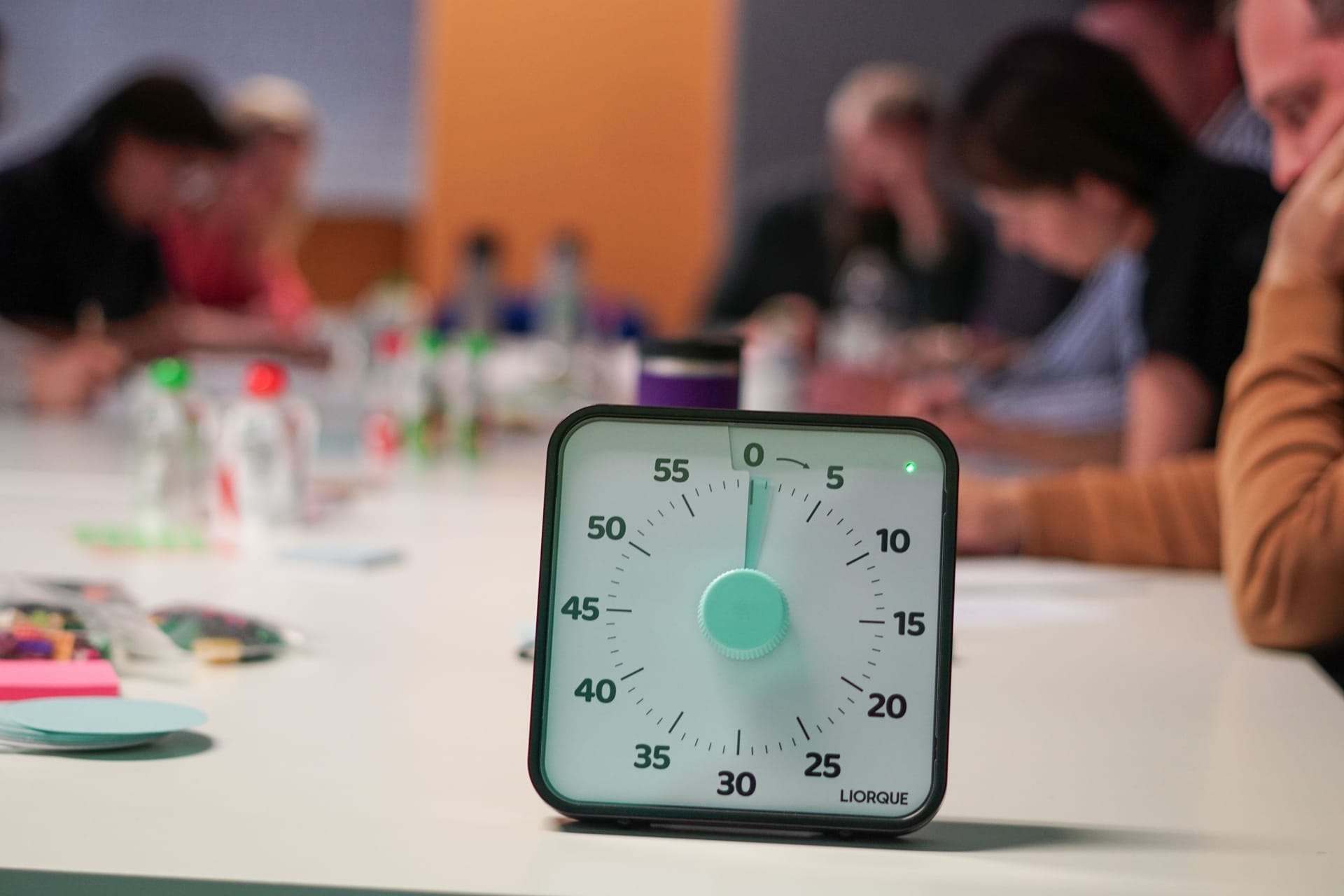
You wake up. You glance at your overflowing to-do list. You sip your coffee. You tell yourself today will be different. Then the hours blur by, and you realize you've spent eight-plus hours in front of a screen, yet you haven't accomplished what actually matters. Sound familiar?
The truth that too many people overlook is simple but profound: time is fixed. Twenty-four hours. Unchanging. But your mental energy is fluid, flexible, and renewable. Your brain isn't a machine that runs at a constant speed all day. Your body carries an internal clock that dictates when you operate at your highest level and when focus slips through your fingers like water. The problem isn't that you lack time. It's that you aren't managing your energy wisely.
In this guide, we'll move beyond rigid time-blocking into the art of energy management, not time. We'll explore how to discover your personal mental peak hours and turn your body's natural rhythms into a genuine productivity tool. This isn't abstract theory. These are steps you can take today. Ready to find out when your mind is truly firing on all cylinders?
Why Time Alone Isn't Enough
The Gap Between Clock Hours and Usable Attention
For generations, we've been taught that productivity means filling every hour with work. This mindset, inherited from an industrial era that's long gone, treats the brain like a machine running at a steady pace. The reality is entirely different. Clock time is just a structural framework on your calendar. An empty container that means nothing without real mental energy to fill it.
Usable attention, by contrast, is a finite resource governed by your prefrontal cortex. Your ability to exercise executive control, process complex data, and resist distraction depends on physiological fuel like brain glucose and balanced oxygenation. When those reserves run low, the hours you've allocated to a task become worthless. Performance drops. Errors multiply. Everything feels heavier than it should.
The linear model says: keep working until you're done. The oscillation model, backed by research, says: work with deep focus, then recover with intention, and your energy will renew. This rhythm of effort and recovery is the secret to sustainable productivity. As performance scientists Jim Loehr and Tony Schwartz observed, human capacity doesn't peak through relentless effort. It peaks through the strategic oscillation between stress and recovery.
The Three Pillars of Mental Energy
Your Personal Energy Map, Peak Hours, and Daily Rhythm
Three core areas determine your capacity for mental work throughout the day.
First, your personal energy map, the practice of tracking your alertness patterns. Your body moves through predictable fluctuations in mental alertness and physical vitality across the twenty-four-hour cycle. At peak energy, your processing speed accelerates, mental friction drops, and focus sharpens. During low periods, reactions slow, distractions multiply, and your mind drifts from the present moment.
Second, your peak hours. These are the biological windows when your internal rhythms align to produce maximum mental alertness. This is the best time for deep mental work, because prefrontal cortex activity is at its highest. During these windows, your brain maintains strong filtering power, screening out irrelevant stimuli and allowing you to enter a flow state, where you accomplish tasks with the least possible effort.
Third, your daily rhythm. The internal clock coordinated by the brain's suprachiasmatic nucleus. This clock regulates basal body temperature, hormone secretion (including melatonin and cortisol), immune responses, and cognitive performance. The interplay between your circadian rhythm and stable sleep pressure shapes your entire performance curve. Pioneering research by Kleitman showed that mental performance fluctuates with body temperature rhythm: as temperature rises, response speed and working memory improve.
Individual differences in this internal clock define your chronotype. Some people are naturally morning-oriented, their minds ignite with the sunrise. Others are evening-oriented, their best work happens when the world sleeps. Neither is wrong. What matters is finding the pattern that fits you.
Practical Tips to Discover and Leverage Your Peak Hours
Track yourself for seven days. Every two hours, from 8 a.m. to 8 p.m., log your alertness level, mental clarity, mood, hunger, fatigue, and distraction. Keep it simple: a single sheet of paper is enough.
Spot the patterns. After one week, review your data. Do you hit maximum focus between 9 and 11 a.m.? Does your energy dip after lunch? This isn't coincidence. It's a biological rhythm worth honoring.
Schedule deep work for your peak hours. Reserve complex analysis, creative writing, and problem-solving for the windows when your energy is highest. This is your golden time. Don't waste it on routine email.
Use low-energy windows for light tasks. Reply to messages, organize files, and schedule meetings during natural energy dips. Don't force your brain when it's asking for a break.
Work in ninety-minute blocks. The body's ultradian rhythm operates in cycles of roughly ninety to one hundred minutes. Focus intensely, then take an active fifteen-minute break: move, hydrate, breathe deeply. Rest isn't laziness. It's essential renewal for your brain cells.
Don't mask fatigue with caffeine. Coffee temporarily suppresses sleep pressure signals, but it doesn't erase your biological need for recovery. Relying on it in the evening disrupts your sleep and deepens the deficit the next morning.

Conclusion
You are not a machine. And you shouldn't operate like one. Time moves in one direction, but your energy is renewable, if you know how to work with it. When you stop fighting your body and start collaborating with it, everything shifts. The same tasks feel lighter. The same day expands to fit what truly matters. And you? You go to bed feeling satisfied, not depleted.
Start today. Track your energy. Identify your peak hours. Give yourself real breaks. Those three steps are enough to transform the way you work.
Looking for extra support on your journey toward alignment with your future self? The Mawj app offers the Focus Channel, a powerful tool designed to reduce internal noise and sustain stable attention. EEG and fMRI findings indicate that users experience clearer thinking. Download the Mawj app and try the Focus Channel as your next step toward a mind more aware of its own energy.
Disclaimer: This article is intended for educational and informational purposes only and is not considered a substitute for specialized medical or psychological consultation. Please always consult professionals when needed.